

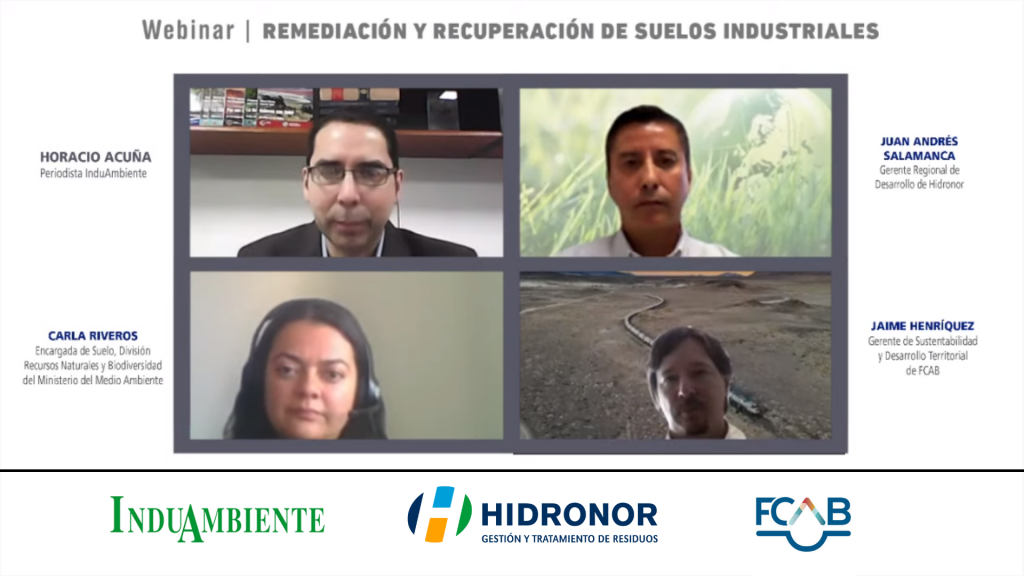
In order to update the industry on current regulations and service alternatives for a correct remediation and recovery of industrial soils, last Wednesday on July 21st, InduAmbiente magazine carried out a webinar on this subject in conjunction with Hidronor.
The event featured a presentation with Hidronor's Regional Development Manager, Juan Andrés Salamanca; Head of Soils, Natural Resources and the Ministry of the Environment (MMA) Division of Biodiversity, Carla Riveros ; and FCAB Sustainability and Territorial Development Manager, Jaime Henríquez.
During the meeting, experts explained to the audience how soil management instruments required by the Ministry of the Environment (MMA) have evolved over time, up to the most current regulations. They also detailed how to properly manage soils with potential contaminants and carry out environmentally friendly projects. Furthermore, the national and international regulations regarding contaminated soils were highlighted, along with an assessment of the situation in Chile.
On this last point, Juan Andrés Salamanca, Hidronor's Regional Development Manager, presented a detailed overview of the state of contaminated soils in Chile, including both active cases and abandoned sites. He also explained the techniques the company uses to remediate and reclaim contaminated land. To do this, after determining key factors such as location, soil type, and contaminant group, Hidronor assesses the feasibility of reusing the land, analyzing the risks to human health and the environment, as well as the technical, economic, and social approach that should be applied in each case.
Finally, there was a round of questions where the exhibitors clarified a few queries made by the audience, thus expanding the latest updates available for the industry regarding the different management alternatives for a correct remediation and recovery of industrial soils.
These types of meetings help us move towards a more sustainable Chile, an objective that is achieved with the alliance of the different groups that contribute to the country's circular economy (companies, government and civil society).