


Un alto porcentaje de empresas en Chile (pertenecientes a distintos sectores) genera residuos industriales que puedes llegar a ser peligrosos, por lo que deben ser manejados adecuadamente para minimizar el impacto ambiental, tal y como establece el Decreto Supremo (DS) 148 del Ministerio de Salud, que corresponde al «Reglamento Sanitario sobre el Manejo de Residuos Peligrosos».
This Decree defines the minimum sanitary and safety conditions that must be applied to the generation, possession, storage, transport, treatment, reuse, recycling, final disposal and other forms of elimination of hazardous waste, establishing the requirements that each company must comply with. to act responsibly and comply with what the law requires.
It is worth noting that for a waste to be considered hazardous it must meet -at least- one of the following characteristics: acute, chronic or extrinsic toxicity; inflammability; reactivity and corrosivity. To determine it, it is necessary to carry out analyzes in certified laboratories to identify the characteristics of each waste and the possible treatments, as well as the necessary care and precautions to take into account in its handling.
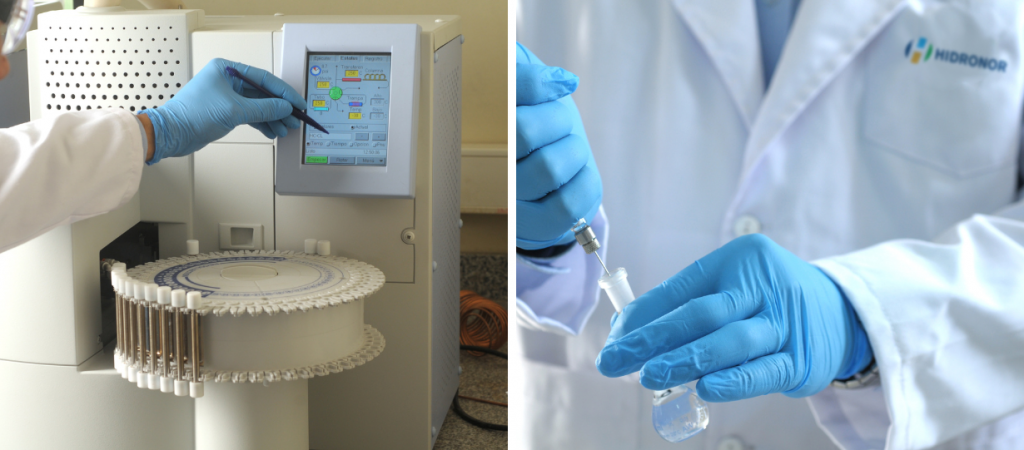
En este sentido, en Hidronor somos la empresa con una de las opciones de caracterización de residuos más completas en todo Chile gracias a nuestros laboratorios acreditados internacionalmente bajo la norma ISO 17025 emitida por el Centro de Expertos en Análisis Ambientales de Quebec (CEAEQ), Canadá. Esta certificación garantiza que cumplimos con los estándares generales de competencia para laboratorios de ensayo y calibración, demostrando que somos técnicamente competentes, contamos con un sistema de gestión y podemos proporcionar resultados técnicamente válidos, confiables y trazables.
We offer services for:
• Hazard determination: Basado en las normas EPA (Agencia de Protección Ambiental de los Estados Unidos), somos capaces de determinar la peligrosidad de residuos por medio de análisis como corrosividad; medición de pH y tasa de corrosión; ensayos de reactividad; medición de ácido cianhídrico y ácido sulfhídrico; toxicidad extrínseca a través del procedimiento de lixiviación de toxicidad característica (TCLP); determinación de inflamabilidad; determinación de punto de inflamación en líquido, según ensayos en copa cerrada Pensky Martens, e inflamabilidad en sólidos presentes en los residuos conforme a la legislación vigente (DS 148), entre otros.
• Analysis of heavy metals in liquid industrial waste (RILes) and solids (RISes): We performed them by applying the methodology of X-ray fluorescence spectrometry and plasma optical emission spectroscopy with inductive coupling for the quantification of heavy metals.
• Characterization of alternative fuels: Los aceites usados y residuos que llegan a nuestras plantas y que cuentan con características de potencia calórica son analizados con un equipo calorimétrico. En caso de cumplir con las condiciones exigidas por la industria (porcentaje de agua, punto de inflamación y metales por FRX), los valorizamos y vendemos como combustible alternativo a empresas cementeras y otras industrias.
• Determination of PCBs: We have the necessary certification to determine Polychlorinated Biphenyls (PCBs) compounds by gas chromatography with a GC-uECD electronic capture detector. PCBs or Askareles are characterized by being highly dangerous for living organisms due to their high toxicity. All companies that, to date, maintain equipment that contains these compounds in operation must stop their use in the year 2025, and subsequently manage their correct disposal within a maximum period of 2028. For this, at Hidronor we also have the capacity to export them correctly so that they can be disposed of in Europe, since our country does not have the necessary technology to ensure that toxic gases are not generated during their incineration, which can be much more toxic than the PCBs themselves.
• Analysis of organic compounds using the GC-MS analytical technique: This service allows us to determine the volatile and semi-volatile organic compounds (such as solvents, pesticides and herbicides) that a residue may contain in order to guide treatment and/or final disposal alternatives for each of them.
Needs more information? Contact our commercial team to help you with your request