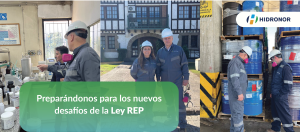


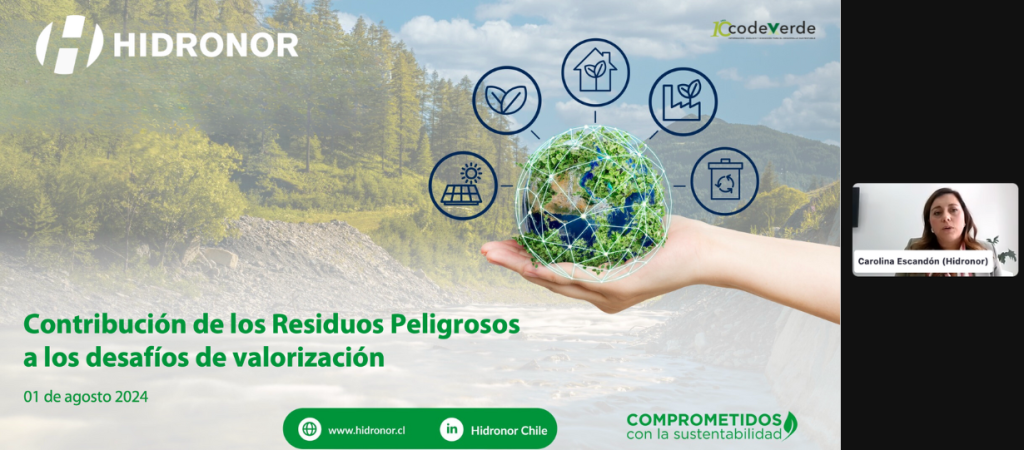

During the meeting we explained to the participants our contribution to the challenges of recovering industrial and hazardous waste.
With the aim of addressing the importance of recycling and waste recovery as an alternative to reducing the generation of waste in landfills, in addition to explaining the contribution that we as Hidronor make to the country thanks to our services focused on the management and treatment of industrial waste and dangerous, we recently participated in the seminar “Transforming waste into energy: challenges and opportunities in Chile”, organized by Codexverde and the School of Biotechnology and Environment of the University of the Americas (UDLA).
Together with prominent executives from the sector, in this instance we seek to promote knowledge and discussion about the best practices that are implemented today in the industry, as well as emerging technologies in waste treatment for recycling and recovery, promoting a sustainable approach. and efficient in waste management.
By way of introduction, Carolina Escandón, Head of Central Zone Sales at Hidronor Chile, highlighted that currently in Chile 18 million tons of waste are generated annually, of which more than 600 thousand correspond to hazardous waste, a figure that draws attention and It requires that as a country we raise awareness in the correct management of waste to reduce its accumulation.
Recovery alternatives: Solid Alternative Fuel (CAS) and Liquid (CAL), aerosols and solar panels
Escandón explained that the energy recovery of solid waste (such as textiles, wood, plastic, among others) “allows us to produce Solid Alternative Fuel (CAS), which replaces the use of fossil fuels, reducing the carbon footprint and contributing to the objectives of the circular economy and a more sustainable operation."
“Likewise, we use discarded liquid industrial waste, such as lubricating oils, solvents and paint residues with calorific value, as raw material to generate Liquid Alternative Fuel (LIC), which, like solids, can be generated by different means. industries, such as pharmaceuticals, chemicals, consumer goods, food, tobacco, among others, so they must all take responsibility for the waste they generate and go to specialized companies (such as Hidronor) to correctly manage their waste,” he added.
On the other hand, the executive warned that, in Chile, more than 90 million aerosols are consumed each year. “About 93% of this waste is destined for landfills, considering that, due to its characteristics, it can be toxic and corrosive, which makes it dangerous waste. At Hidronor we create an innovative solution to valorize this waste through the implementation of a process that decontaminates the containers, changing their characterization from hazardous waste to “non-hazardous”, so they can be sent to any recipient authorized for waste revaluation. non-hazardous metallic materials, thus facilitating the reintegration of this product into the production process.”
Added to these recovery alternatives is Hidronor's capacity to recover solar panels, which, due to the growth of this sector, are estimated to produce close to 300 thousand tons of waste by 2050. “Seeking to reduce these figures and continue contributing to environmental sustainability in Chile, at Hidronor we have the capacity to recycle up to 77% of the waste generated by the accumulation of solar panels or allocate less than 30% of these to confinement, thus contributing to the country's circular economy, in addition to compliance with the REP Law and the companies' environmental sustainability policies. We extract the aluminum, glass and the photovoltaic cell itself to reinsert its components into the production chain,” he commented.
Finally, the meeting allowed those present to clarify some doubts with the experts, who added valuable information to conclude this productive meeting.
At Hidronor we remain committed to the objectives of the circular economy and a more sustainable operation thanks to the recovery of waste!
You can review Carolina Escandón's presentation in the following link.