


¿Qué es el asbesto y por qué es un residuo peligroso?
Asbestos is an element present in nature that, due to its physical characteristics, is resistant to heat and corrosion. For this reason, it is used in commercial products, such as fireproof and insulation materials for construction, industry in general, anti-flame clothing, automotive area, among others.
The importance of correctly handling asbestos materials is that, if they are altered, small fibers of this element are released into the air, which, when inhaled by humans, can cause inflammation and scarring of tissue in the lungs, affecting breathing and causing serious health problems, as well as lung cancer and mesothelioma (cancer of the thin membranes that line the inside of the chest and abdomen).
Asbesto friable y no friable
Within the different types of asbestos, there are two large groups: streamers and amphibolites, which in turn are subdivided into different types according to their characteristics. On the latter (amphibolites) they can be found in two forms: Friable Asbestos (MCAF) and Non-Friable Asbestos (MCANF). The MCAF is found free, in sleeves, packages, or as part of a material in crumble condition; For its part, the MCANF is encapsulated with some material that does not allow a work or building to be completely crumbled.
Having this information clear, the question then arises, how to handle and dispose of asbestos safely?
Cómo retirar asbesto: el plan de trabajo ante la SEREMI
Es importante tener en cuenta que Chile prohibió el uso de materiales de construcción que contengan asbesto en el año 2001. Así, para el retiro, manejo y disposición de este material es importante conocer las directrices de la Seremi de Salud, que cuenta con un Manual para la elaboración de un Plan de Trabajo con materiales que contienen Asbesto Friable y No Friable. En el caso del tipo de asbesto MCAF, el plan de trabajo debe ser presentado ante la misma Seremi para su correspondiente autorización sanitaria.
For the MCANF, the executing company must inform the Health Authority 72 hours in advance, the start of the works, attaching a Work Plan, which must contain all the technical background and supporting documents that allow justifying the measures established in said Plan.
Retiro y disposición final de asbesto con Hidronor
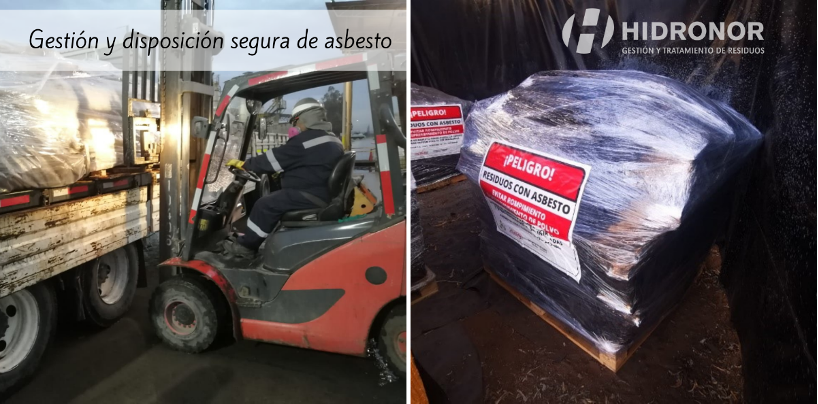
Como empresa experta en la correcta gestión y disposición segura de asbesto, en Hidronor contamos con gran experiencia en trabajos de este tipo. Además, ofrecemos un servicio más completo que consiste en la elaboración y presentación de los planes de manejo de asbesto, retiro y disposición del mismo.
El material retirado es un residuo peligroso: se traslada con transporte autorizado y termina en un depósito de seguridad para su disposición final, con la documentación que exige el Decreto Supremo 148. Contact us para cotizar el retiro y la disposición de asbesto en tu obra o instalación.